Earth Filling
Sub-Service
Earth Filling Services in Dhaka: Expert Solutions for Construction and Land Development
Are you looking for professional earth filling services in Dhaka? ASF Corporation provides comprehensive earth filling solutions for construction projects, land development, and site preparation across Dhaka and surrounding areas. With our experienced team and advanced equipment, we ensure your project has the stable foundation it needs for success.
Safety First
Prioritizing protection and well-being to prevent accidents and ensure security.
Competitive Pricing
Offering attractive rates to stay attractive in the market and attract customers
Timely Completion
Finishing tasks on schedule, meeting deadlines, and ensuring efficient progress.
What is Earth Filling?
Earth filling, also known as land filling or soil filling, is a fundamental construction process that involves filling excavated or uneven areas with soil or earth materials to create a stable, level base for various construction activities. This essential technique serves as the groundwork for building foundations, roadways, and other infrastructure projects, ensuring structural stability and longevity.
At ASF Corporation, we understand that proper earth filling is crucial for the success of any construction project. Our specialized services are designed to meet the specific requirements of residential, commercial, and industrial developments throughout Dhaka.
Our Earth Filling Services
ASF Corporation offers a comprehensive range of earth filling services tailored to meet your specific project requirements:
Mass Earth Filling Works
Our mass earth filling service is ideal for large-scale projects requiring significant volumes of soil to level or raise land elevation. We handle projects of all sizes, from residential plots to commercial developments and industrial sites.
Site Grading & Land Leveling
We provide precise site grading and land leveling services to ensure your construction site has the proper slope for drainage and stability. Our expert team uses advanced surveying equipment to achieve accurate grading according to your project specifications.
Earth Basement Filling
Proper basement filling is critical for structural integrity. Our team specializes in basement filling services that ensure optimal compaction and stability for your building’s foundation.
Soil Selection and Testing
We carefully select appropriate soil based on your project requirements, considering factors such as load capacity and drainage needs. Our soil testing services help determine the optimal soil composition for your specific construction project.
Clearing and Preparation
Before beginning the earth filling process, we thoroughly clear the area of debris, rocks, vegetation, and other obstacles to ensure a clean slate for your project.
Our Earth Filling Process
At ASF Corporation, we follow a methodical approach to earth filling that ensures quality results:
Site Survey and Assessment
Our process begins with a comprehensive site survey to understand the current topography and elevation of your land. Our surveyors use advanced tools like GPS and laser levels to map out the site’s highs and lows, helping our engineers determine precisely where cutting and filling should occur.
Planning and Design
Based on the survey results, our engineers create a detailed plan outlining where cuts and fills will take place. This plan includes diagrams showing current and desired elevations, along with calculations of how much earth needs to be moved and placed. A well-thought-out plan ensures the process will be efficient and cost-effective.
Site Preparation
We clear the area of all debris, vegetation, rocks, and other obstacles to create a clean foundation for the earth filling work.
Excavation and Cutting
Using bulldozers and excavators, we begin the cutting process in higher areas of the land. Our equipment operators skillfully remove soil from elevated sections and prepare it for transport to areas that need filling.
Earth Filling and Spreading
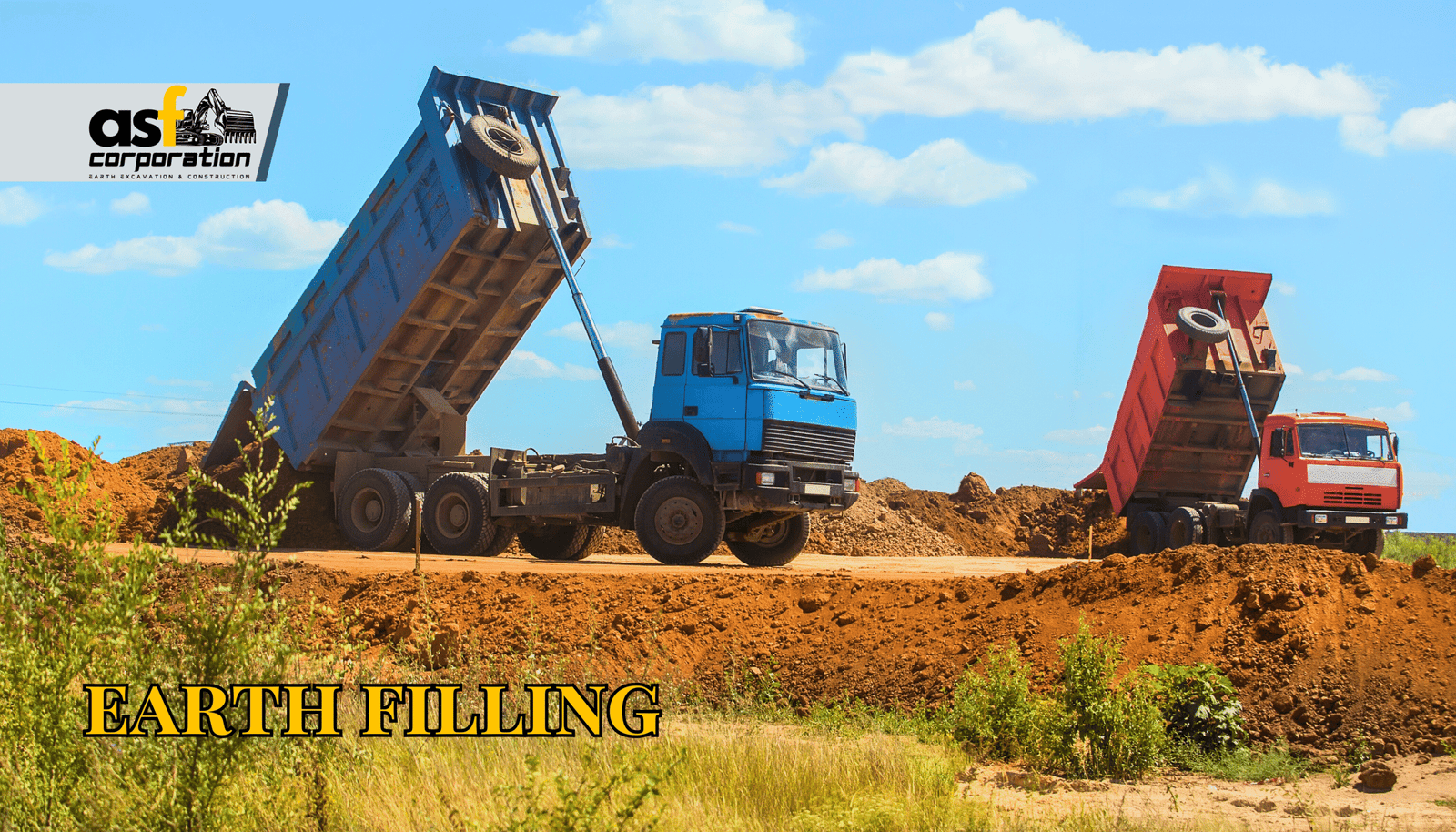
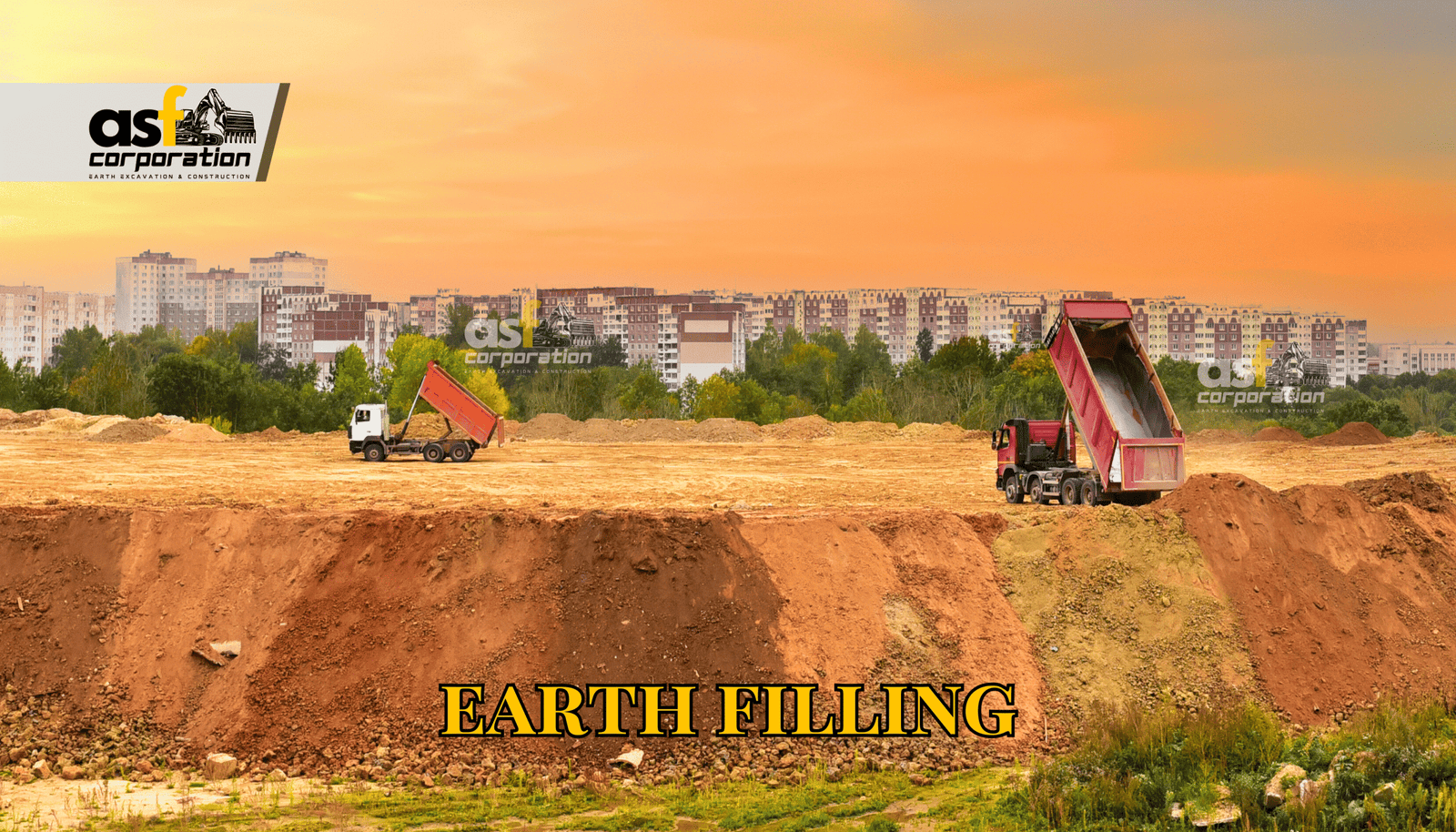
The soil removed during cutting is transported to fill sites, where it’s spread evenly using graders and bulldozers. Our goal is to raise low spots to match the desired elevation, creating a smooth and level surface across the entire site.
Compaction
After spreading the fill material, we perform thorough compaction to remove air pockets and increase soil density. This crucial step prevents future settling that could damage structures built on the site. We use specialized compactors with large rollers or plates to compress the soil, making it firm and stable.
Quality Control and Testing
Throughout the process, we conduct regular testing to ensure the fill material meets the required specifications and the compaction achieves the necessary density for your project requirements.
Final Grading and Leveling
Once the filling and compaction are complete, we perform final grading to ensure proper drainage and prepare the site for construction.
Benefits of Professional Earth Filling Services
Stable Foundation for Construction
Professional earth filling creates a solid, stable base for buildings, roads, and other structures, reducing the risk of settlement and structural issues in the future.
Improved Drainage
Proper earth filling and grading ensure effective water drainage, preventing water accumulation that can damage foundations and cause erosion.
Cost-Effective Solution
Earth filling is a cost-effective method for preparing construction sites compared to other alternatives. It utilizes natural materials and can be completed efficiently with the right equipment and expertise.
Environmental Benefits
When done properly, earth filling can help conserve valuable topsoil and reduce the need for mining or other environmentally damaging activities.
Versatility
Earth filling can be used for various applications, from creating level surfaces for construction to building up elevations for specific design requirements.
Why Choose ASF Corporation for Earth Filling in Dhaka?
Local Expertise
As a Dhaka-based company, we understand the local soil conditions, regulations, and construction requirements specific to Bangladesh. Our team has extensive experience working in Vashantek, Dhaka Cantonment, and throughout the greater Dhaka area.
Quality Materials
We use only high-quality fill materials that are free from lumps, clods, roots, vegetation, harmful salts, chemicals, and organic materials that could compromise the stability of your project.
Advanced Equipment
Our company is equipped with modern earth-moving machinery, including excavators, bulldozers, compactors, and graders, allowing us to handle projects of any size efficiently and effectively.
Experienced Team
Our skilled operators and engineers have years of experience in earth filling and site preparation, ensuring your project is completed to the highest standards.
Comprehensive Services
From initial site assessment to final compaction and testing, we provide end-to-end earth filling services, eliminating the need to coordinate with multiple contractors.
Timely Completion
We understand the importance of keeping your construction project on schedule. Our efficient processes and adequate resources ensure timely completion of earth filling work.
Earth Filling Applications
Our earth filling services are suitable for a wide range of applications:
Residential Construction
We provide earth filling services for residential plots, housing developments, and individual home construction projects throughout Dhaka.
Commercial Development
Our team handles earth filling for commercial buildings, shopping centers, office complexes, and other commercial developments.
Industrial Projects
We offer specialized earth filling solutions for industrial facilities, factories, warehouses, and manufacturing plants.
Infrastructure Development
Our services support infrastructure projects including roads, bridges, airports, and utility installations.
Land Reclamation
We help reclaim low-lying or waterlogged areas, transforming them into usable land for development.
Our Service Areas in Dhaka
ASF Corporation provides professional earth filling services throughout Dhaka and surrounding areas, including:
- Vashantek
- Dhaka Cantonment
- Mirpur
- Uttara
- Banani
- Gulshan
- Mohakhali
- Tejgaon
- Mohammadpur
- Dhanmondi
- Bashundhara
- Badda
- Khilkhet
- Tongi
- Gazipur
No matter where your project is located in the Dhaka metropolitan area, our team is ready to provide expert earth filling services to meet your needs.
The Importance of Proper Compaction
One of the most critical aspects of earth filling is proper compaction. Without adequate compaction, filled soil can settle over time, leading to uneven surfaces, foundation cracks, and structural problems.
At ASF Corporation, we place special emphasis on thorough compaction of fill materials. We follow these best practices:
- We apply fill in layers not exceeding 250mm in loose thickness
- Each layer is watered to achieve optimal moisture content
- We use mechanical compaction equipment to ensure uniform density
- Compaction continues until the required density is achieved
- We perform regular testing to verify compaction meets specifications
This methodical approach ensures the long-term stability of your project and prevents costly issues related to soil settlement.
Earth Filling Cost Factors
Several factors influence the cost of earth filling services:
- Volume of fill material required
- Type and quality of fill material
- Distance from the source of fill material to the project site
- Site accessibility and conditions
- Degree of compaction required
- Project timeline
At ASF Corporation, we provide transparent pricing and detailed estimates based on your specific project requirements. Contact us today for a free consultation and quote for your earth filling needs.
Environmental Considerations
ASF Corporation is committed to environmentally responsible practices in all our earth filling operations. We take several measures to minimize environmental impact:
- We carefully select fill materials that are free from contaminants
- Our processes include erosion control measures to prevent soil runoff
- We implement dust control methods during dry conditions
- When possible, we source fill materials locally to reduce transportation emissions
- We comply with all environmental regulations and best practices
Our goal is to provide effective earth filling services while protecting the natural environment for future generations.
Frequently Asked Questions
What is Earth Filling?
Earth filling is a fundamental construction process that involves filling excavated or uneven areas with soil or earth materials to create a stable, level base for various construction activities. It serves as the groundwork for building foundations, roadways, and other infrastructure projects, ensuring structural stability and longevity.
What Materials Are Suitable for Earth Filling?
Suitable earth filling materials must be free from vegetable matter, roots, shrubs, grass, grass roots, and structures. The material should be of an appropriate nature and moisture content that allows it to be compacted to form a stable layer. For road embankments, the California Bearing Ratio (CBR) of the material should be more than 3%.
How Is Earth Filling Typically Done?
Earth filling is typically done in layers of approximately 150mm thickness. Each layer must be properly compacted before adding the next layer. The layers should be approximately parallel to the finished grade. Before spreading a new layer, the engineer must approve the last compacted layer.
What Level of Compaction Is Required for Earth Filling?
For general earth filling in foundation trenches and plinth, a minimum dry density of 95% with optimum moisture content (modified proctor test) is required. For road embankments, the material when compacted should achieve 95% maximum dry density (MDD). For shoulders, each layer should be compacted to achieve not less than 98% MDD with ±2% optimum moisture content.
How Is the Quality of Compaction Verified?
Compaction tests are conducted to verify the quality of compaction. For road embankments, one compaction test should be carried out for each 1000 square meters of completed layer. For shoulders, compaction tests should be carried out for every 500 square meters of constructed area. These tests determine the field dry density (FDD) of the compacted soil.
What Preparation Is Needed Before Earth Filling?
Before placing any material, clearing and grubbing and the removal of any unsuitable materials needs to be completed. Cross-sections of the original ground should be taken to determine earthwork quantities. When widening an existing embankment, the new fill material must be fully keyed into the old embankment by means of benching.
What Are the Special Considerations for Embankment Widening?
When widening an existing embankment, steps not less than 300 mm high and 600 mm wide should be cut into the old embankment prior to any filling. This process, known as benching, ensures proper integration of the new fill with the existing embankment. Material cut from these benches may be used as fill if it is suitable.
How Deep Should Soil Investigations Go Before Construction?
For building structures, soil investigations should typically extend to a depth equal to 1.5 times the width of the building below the lowest part of the foundation. For individual footings where length is less than or equal to two times width, investigations should go at least two footing widths below the anticipated bearing level. For footings where length is greater than five times width, investigations should extend to four footing widths below the bearing level.
What Are the Requirements for Sub-base Materials in Road Construction?
Sub-base materials should be natural or artificial aggregate material, free from vegetation, soft particles, and excess clay. The material should have a 4-day soaked CBR value greater than 25% when compacted to 98% MDD. The aggregate crushing value (ACV) should be less than 38%, and the ten percent fine value (TFV) should be greater than 75kN, or as specified in the contract.
How Is Earth Filling Priced and Measured?
Earth filling is typically priced per cubic meter (cum) of fill material. The cost includes carrying, watering, leveling, dressing, and compacting the soil to a specified percentage. For example, earth filling in foundation trenches and plinth in 150 mm layers with earth available within 90 meters of the building site is priced at approximately TK 371.00 per cubic meter according to one source. Prices may vary based on local conditions and specific project requirements.
Get Started with ASF Corporation Today
Ready to begin your earth filling project in Dhaka? ASF Corporation is here to help. Our experienced team will work closely with you to understand your specific requirements and develop a customized solution for your project.
Contact Us for a Free Consultation
ASF Corporation
Address: Vashantek, Dhaka Cantonment
Dhaka-1206, Bangladesh
Phone: +88 01907-636827
Email: info@asfcorporation.com
Don’t settle for inexperienced contractors for your earth filling needs. Choose ASF Corporation for professional, reliable, and high-quality earth filling services in Dhaka. Contact us today to schedule a site visit and receive a detailed proposal for your project.
Transform your land with expert earth filling services from ASF Corporation – Building solid foundations for Dhaka’s future.
Download Brochure
BENEFITS

Rigorous attention to detail ensuring accurate earthwork execution.

Application of cutting-edge technology for cost-effective operations.

Comprehensive service covering all aspects of mass earthworks.

Efficient and timely completion of tasks to keep your project on schedule.
Frequently Asked Questions (FAQ’s)
What is land development?
Land development involves preparing land for construction or other uses by altering its terrain, utilities, and infrastructure to meet planning and zoning requirements.
What is dredging and how is it related to land development?
Dredging is the process of removing sediment and debris from the bottom of water bodies to improve depth, flow, or usability, often supporting land reclamation or flood control in development projects.
Why is dredging important in Bangladesh?
Due to heavy siltation in rivers and frequent flooding, dredging is critical in Bangladesh for maintaining navigable waterways and developing flood-resistant infrastructure.
Do I need permits for land development or dredging?
Yes, both activities typically require environmental and government permits to ensure legal compliance and minimal ecological impact.
What equipment is used for land development and dredging?
Equipment includes excavators, bulldozers, dump trucks, dredgers (like cutter suction or bucket dredgers), and surveying tools.
Is dredging environmentally safe?
When managed properly with environmental assessments and mitigation plans, dredging can be conducted safely, although it can disrupt aquatic ecosystems if done irresponsibly.
How long does a land development or dredging project take?
Timelines vary by project size, complexity, weather conditions, and regulatory approvals—ranging from weeks to several months.
Can land development include flood control or drainage planning?
Absolutely. Proper land development includes grading, drainage, and flood mitigation strategies to ensure long-term sustainability.
What are the costs involved in land development and dredging?
Costs depend on the scale of the project, location, soil conditions, water depth, and environmental requirements. A site assessment is usually needed for accurate estimates.
Land development involves preparing land for construction or other uses by altering its terrain, utilities, and infrastructure to meet planning and zoning requirements.
Dredging is the process of removing sediment and debris from the bottom of water bodies to improve depth, flow, or usability, often supporting land reclamation or flood control in development projects.
Due to heavy siltation in rivers and frequent flooding, dredging is critical in Bangladesh for maintaining navigable waterways and developing flood-resistant infrastructure.
Yes, both activities typically require environmental and government permits to ensure legal compliance and minimal ecological impact.
Equipment includes excavators, bulldozers, dump trucks, dredgers (like cutter suction or bucket dredgers), and surveying tools.
When managed properly with environmental assessments and mitigation plans, dredging can be conducted safely, although it can disrupt aquatic ecosystems if done irresponsibly.
Timelines vary by project size, complexity, weather conditions, and regulatory approvals—ranging from weeks to several months.
Absolutely. Proper land development includes grading, drainage, and flood mitigation strategies to ensure long-term sustainability.
Costs depend on the scale of the project, location, soil conditions, water depth, and environmental requirements. A site assessment is usually needed for accurate estimates.